In This Guide
- Why Goa is a great place to dive for beginners
- Grande Island: the dive site explained
- What your first dive actually looks like
- Equipment and training overview
- Marine life you will see
- Real cost breakdown for diving
- Safety rules every beginner must know
- How to book scuba diving for groups
- Scuba diving FAQ
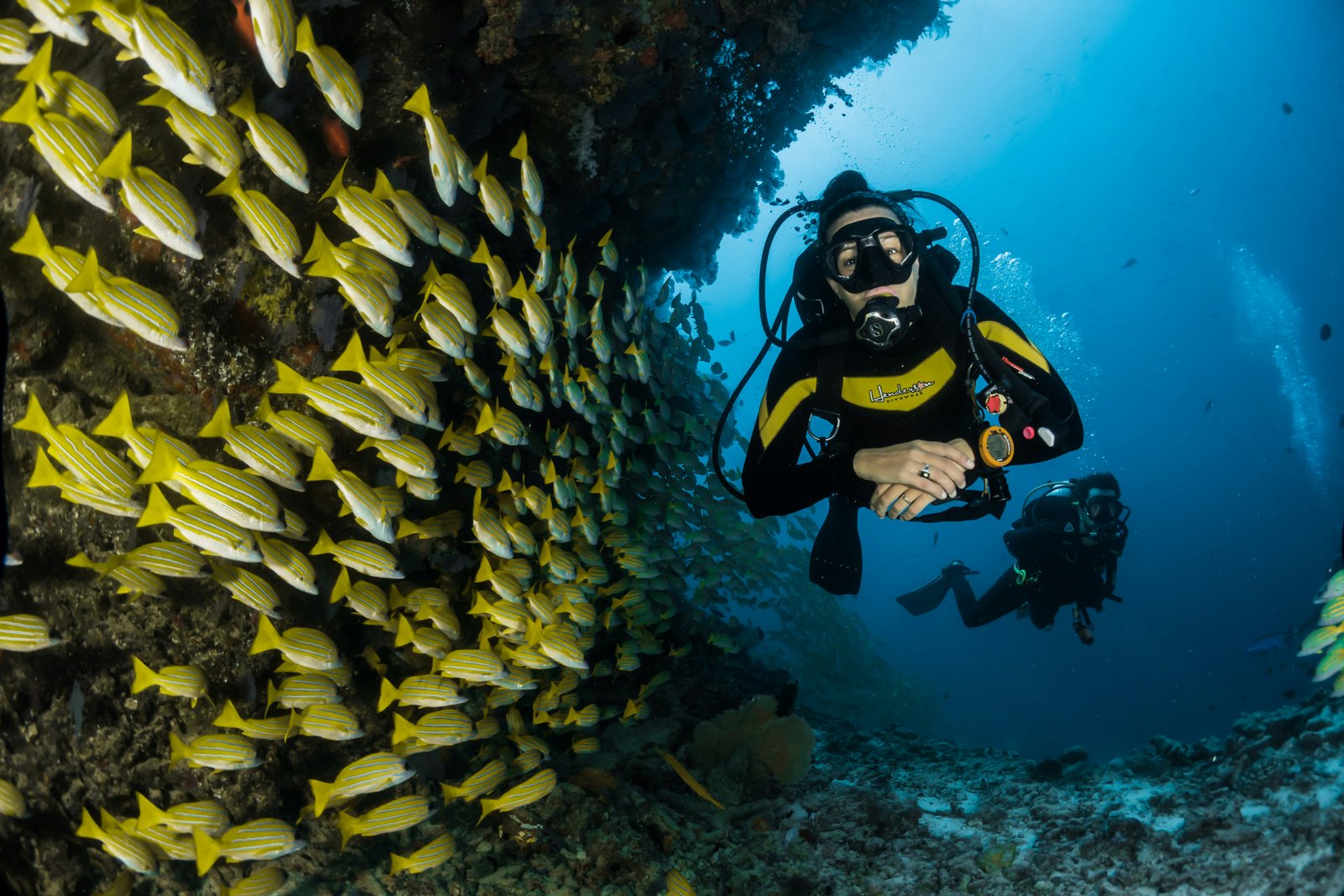
There is a moment during your first scuba dive when you stop thinking about the equipment, the mask, the regulator and the instructor and just look around. And you realise you are floating in a completely different world. Fish moving in and out of coral formations. Sunlight filtering through the water. The muffled sound of your own breathing. It is a feeling that is hard to describe and impossible to forget.
Most people who have never dived assume it is complicated, dangerous or requires years of training. It is none of those things. Beginner scuba diving in Goa is one of the easiest and safest adventure activities available to travellers. You do not need to know how to swim expertly. You do not need any certification. You just need to be reasonably comfortable in water, listen to your instructor and follow a few simple rules.
This guide is what we share with every group that books a scuba diving experience with us at GoaThrills. It covers everything from what happens on your first dive to what marine life you will see to how much it costs and how to choose a safe operator. If you want us to include scuba diving in your group trip with hotels, transport and other activities bundled, message us on WhatsApp and we will build a package for you.
1. Why Goa is a great place to dive for beginners
Goa is not the Maldives or the Andamans. The underwater visibility is not as crystal clear, and the coral formations are not as dramatic. But for beginners, Goa offers several advantages that make it an excellent place to try scuba diving for the first time.
The first is accessibility. Goa is well connected by flights, trains and roads from every major Indian city. Diving is available year-round (with the exception of monsoon months). The dive sites are close to the coast, usually a 30 to 60 minute boat ride from shore. This means you can book a dive as a half-day activity without committing to a multi-day trip.
The second is cost. Scuba diving in Goa is significantly cheaper than the Andamans or international destinations. A single beginner dive costs Rs 3,500 to Rs 5,500 per person, including boat, equipment, instructor and training. Comparable dives in Thailand or the Maldives cost three to four times more.
The third is calm conditions. Grande Island, the most popular dive site in Goa, is sheltered from rough seas during most of the year. Water depths for beginner dives are 5 to 12 metres, which is well within safe limits. The instructors are experienced and patient with first-timers.
The one thing beginners should know
The biggest fear for first-time divers is not the water. It is the equipment. Regulators, masks, BCDs, weight belts and gauges can feel overwhelming. But by the end of the 20 to 30 minute training session, everything becomes automatic. The instructor will not let you descend until you are comfortable with every piece of equipment.
2. Grande Island: the dive site explained
Grande Island, also known as Ilha Grande, is a small uninhabited island about 8 nautical miles off the coast of Vasco da Gama. It is the most popular scuba diving site in Goa and the standard choice for beginner dives.
Location and access
The island is reached by boat from either the Goa coastline near Vasco or from various jetties along the coast. Most dive centres operate from the Sinquerim, Candolim, Calangute or Vasco areas. The boat ride to Grande Island takes 30 to 45 minutes depending on the departure point and sea conditions.
Underwater landscape
Grande Island has a mix of coral reefs, rocky formations and sandy bottoms. Beginner dives are conducted at depths of 5 to 12 metres on the shallower side of the island. Visibility ranges from 5 metres on a bad day to 15 metres on a clear day. The best visibility is usually in the morning before the wind picks up.
Why it works for beginners
- Calm, sheltered water on most days
- Shallow depths (5 to 12 metres)
- Variety of marine life in a small area
- Well-established dive infrastructure with certified operators
- Short boat ride from the coast
- Combine with snorkelling and beach time for a full-day experience
Other dive sites in Goa
- Suzy's Wreck: A sunken ship, best for certified divers (open water or above). Depth 20 to 25 metres.
- Sail Rock: Rocky formation with strong currents, best for experienced divers.
- Pigeon Island: Another beginner-friendly site with coral and rocky formations.
- Bounty Bay: Shallow reef site with good visibility on calm days.
3. What your first dive actually looks like
The first dive is a full process, not just a jump into the water. Here is what to expect from beginning to end.
Arrival at the dive centre
You arrive at the dive centre or meet the operator at the arranged point. You fill out a medical declaration form (this is mandatory). You are given a basic briefing on the day plan, safety rules and what to expect.
Boat ride to Grande Island
You board the dive boat and take a 30 to 45 minute ride to Grande Island. Most operators provide water, snacks and sunscreen (do not apply sunscreen within an hour of diving). This is a good time to relax and get mentally prepared.
Training session
Before entering the water, you get a 20 to 30 minute training session with your instructor. This covers hand signals, how to breathe through a regulator, how to clear your mask if water enters, how to equalise ear pressure, and what to do if you feel uncomfortable. You practice these in shallow water until you are comfortable.
Equipment fitting
You are fitted with a wetsuit, BCD (buoyancy control device), regulator, mask, fins and weight belt. Everything is checked twice before you enter the water. Your instructor stays close to you the entire time.
The dive
You descend slowly, holding on to a rope or your instructor. The dive lasts 20 to 30 minutes. You are guided through the reef, shown marine life and can spend time floating and looking around. Your instructor is within arm's reach throughout. The maximum depth is 5 to 12 metres.
Surfacing and return
You ascend slowly with your instructor, taking time to equalise and adjust. Once back on the boat, you remove equipment and rest for a bit. The boat returns to shore. Most operators provide photographs and videos of your dive (sometimes for an extra cost).
The total duration of a beginner dive experience, from meeting point to return, is about 4 to 6 hours. The actual underwater time is 20 to 30 minutes. The rest is training, boat rides and transition time.
4. Equipment and training overview
Every piece of equipment you use is designed to keep you safe. Here is what you will be using and what each piece does.
| Equipment | What It Does | What to Know |
|---|---|---|
| Mask | Lets you see clearly underwater | If water enters, exhale through your nose while pressing the top of the mask to clear it |
| Regulator | Delivers air from the tank | Always breathe normally. Never hold your breath. Exhale slowly and continuously. |
| BCD (Buoyancy Control Device) | Controls your buoyancy | Inflate to float, deflate to descend. Your instructor controls this on your first dive. |
| Weight Belt | Helps you descend | Your instructor adjusts the weight to your body type |
| Wetsuit | Keeps you warm and protects against cuts | Provided by the operator in appropriate sizes |
| Fins | Helps you move through the water | You will mostly hover during your first dive, not swim |
| Tank | Holds compressed air | Your instructor monitors the air supply throughout |
| Pressure Gauge | Shows air remaining | Your instructor checks this regularly |
Training topics covered before your dive
- Hand signals: OK, not OK, go up, go down, stop, low air, look
- Breathing technique: Slow, deep, continuous. Never hold your breath.
- Equalisation: Pinching your nose and blowing gently to equalise pressure in your ears
- Mask clearing: How to remove water from your mask underwater
- Regulator recovery: How to find and replace the regulator if it comes out of your mouth
- Buoyancy basics: How to control your body position underwater
5. Marine life you will see
The marine life at Grande Island is diverse, even if the underwater visibility is not always perfect. Here is what you are likely to see on a typical beginner dive.
Fish
- Parrotfish: Colourful fish often seen feeding on coral
- Angelfish: Recognizable by their flat bodies and distinctive patterns
- Butterflyfish: Small colourful fish often seen in pairs
- Groupers: Larger, calm fish often found near rocky formations
- Snappers: Often seen in schools
- Lionfish: Beautiful but venomous, seen at a distance
- Moray eels: Often seen peeking out from crevices
Other marine life
- Sea turtles: Sometimes seen, especially near rocky formations
- Stingrays: Often found on sandy bottoms
- Nudibranchs: Small colourful sea slugs
- Starfish: Common on sandy patches
- Dolphins: Occasionally spotted during the boat ride
Coral and rocks
Grande Island has a mix of hard coral, soft coral and rocky formations. The coral is not as pristine as the Maldives or Andamans, but it hosts a lot of marine life and provides structure for the reef ecosystem.
Best time for visibility
The best visibility at Grande Island is usually in the morning, from 7 AM to 11 AM, before the wind picks up. If you can choose a morning dive slot, do it. The water is calmer and visibility is better.
6. Real cost breakdown for diving
Here are the honest costs for scuba diving in Goa. Prices vary by operator, season and whether you book directly or through a DMC.
| Experience | Duration | Per-Person Cost | Inclusions |
|---|---|---|---|
| Snorkelling at Grande Island | 2 to 3 hours | Rs 1,500 to Rs 2,500 | Boat, snorkel gear, guide, beach time |
| Beginner Discover Scuba (1 dive) | 4 to 6 hours | Rs 3,500 to Rs 5,500 | Training, equipment, 1 dive, boat, instructor |
| Beginner Scuba (2 dives) | Full day | Rs 6,500 to Rs 9,500 | Training, equipment, 2 dives, boat, instructor, lunch |
| PADI Open Water Certification | 3 to 4 days | Rs 25,000 to Rs 40,000 | Training, certification, equipment, 4 to 5 dives, study materials |
| Underwater Photography Add-On | During dive | Rs 1,500 to Rs 3,000 | Photographer, photos and video of your dive |
These costs are per person and exclude travel to Goa and accommodation. For groups of 6 or more, we negotiate discounted rates with our partner dive centres that bring the per-person cost down by 10 to 20 percent.
7. Safety rules every beginner must know
Scuba diving is safe when the rules are followed. Every dive centre has its own protocols, but here are the universal rules that apply everywhere.
Before diving
- Do not dive if you have a cold, fever or respiratory issue. This is non-negotiable. Diving with a cold can cause serious ear and sinus damage.
- Disclose all medical conditions honestly. Asthma, heart conditions, epilepsy, diabetes and ear problems need to be discussed with the dive operator.
- Do not consume alcohol within 24 hours of diving. Alcohol increases the risk of decompression sickness and impairs judgement.
- Do not fly within 24 hours after diving. Give your body time to release the nitrogen absorbed during diving.
- Get adequate sleep the night before. Diving requires focus and calm.
During the dive
- Never hold your breath. Breathe slowly and continuously.
- Equalise regularly. Pinch your nose and blow gently every few feet of descent.
- Stay close to your instructor. Do not wander off or explore on your own.
- Signal discomfort immediately. If anything feels wrong, use the "not OK" hand signal.
- Follow the dive plan. Do not exceed the depth or time limits set by your instructor.
- Do not touch coral or marine life. It is unsafe for you and harmful for the reef.
After the dive
- Rest and hydrate. Drink water, eat something light and take it easy for an hour or two.
- Do not rush to fly. Wait at least 24 hours after your last dive before flying.
- Watch for any unusual symptoms. Report any pain, dizziness or skin changes to the dive operator.
How we ensure safety for our divers
Every dive we book for our clients is with a PADI or SSI certified operator with a verified safety record. We check operator certifications, equipment maintenance logs and instructor credentials before adding them to our partner list. Every dive we book includes comprehensive safety briefing and equipment verification. We do not book diving with unverified operators or during monsoon months.
8. How to book scuba diving for groups
Scuba diving works beautifully as a group activity. The shared experience of discovering the underwater world together creates stories that last for years. Here is how we handle group diving at GoaThrills.
Message us on WhatsApp with group details
Tell us group size, dates, and whether anyone has prior diving experience. We will respond with a plan and pricing within minutes.
Get your itemised quote
We share per-person costs for different diving options: snorkelling, beginner dive, two-dive package, or certification. Every inclusion and exclusion is clearly stated.
Confirm and book
Once you approve the quote, we book the dive centre, confirm instructor-to-diver ratios and arrange all logistics. For groups over 10, we deploy additional instructors and dedicated boats.
Safety briefing and medical declarations
Before the dive, we share medical declaration forms with your group and collect them in advance. We also send a safety briefing that covers what to expect and what to avoid.
Coordinate with your overall trip
If diving is part of a larger group tour, we integrate the dive day into the overall itinerary. Transport, meals and other activities are coordinated around the dive schedule.
Scuba diving works well as part of a broader adventure package. If you want to see how it fits into a 4 or 5-day group itinerary, our 5 days 4 nights itinerary guide covers how we structure multi-activity trips. For a general overview of group tour options, our Goa group tour packages guide has more detail.
Ready to book scuba diving for your group?
Tell us group size and dates. We will send a full diving plan on WhatsApp.
9. Scuba diving FAQ
No prior experience is needed. Goa scuba diving for beginners is designed for first-time divers. The dive typically starts with a 20 to 30 minute training session at the dive centre or on the boat, covering basic hand signals, breathing techniques and equalisation. A certified dive instructor then accompanies you underwater at depths of 5 to 12 metres, holding your hand or staying within arm's reach throughout.
Grande Island (also called Ilha Grande) is the best place to scuba dive in Goa. It is a small island about 8 nautical miles off the coast near Vasco da Gama, with coral reefs, rocky formations and a variety of marine life. Other diving spots include Suzy's Wreck (a shipwreck), Sail Rock, and Pigeon Island. Grande Island is the most popular for beginner divers because the water is calmer and the depth is manageable.
Beginner scuba diving in Goa at Grande Island costs Rs 3,500 to Rs 5,500 per person for a single dive, including boat transfer, equipment, instructor and training. A two-dive package costs Rs 6,500 to Rs 9,500. Snorkelling at Grande Island costs Rs 1,500 to Rs 2,500 per person. For groups, we negotiate discounted rates that bring the per-person cost down by 10 to 20 percent.
Yes, scuba diving in Goa is safe when done with certified operators. Goa has PADI and SSI certified dive centres with trained instructors, modern equipment and safety protocols. The dive is at shallow depths (5 to 12 metres) which reduces risk. However, beginners must follow safety rules, disclose medical conditions, and never dive if they have a cold, fever or respiratory issue. GoaThrills only works with certified operators with verified safety records.
The best time to go scuba diving in Goa is October to May. During these months, the sea is calm, underwater visibility is 5 to 15 metres, and all dive centres are operational. Monsoon (June to September) is not recommended as the sea is rough and visibility drops significantly. Peak diving season is November to February, but October and March to April offer great conditions with fewer crowds.
Common marine life at Grande Island includes parrotfish, angelfish, butterflyfish, groupers, snappers, sea turtles, moray eels, stingrays, lionfish and occasionally dolphins on the boat ride. The coral reefs and rocky formations also host nudibranchs, sea stars and small reef fish. Visibility varies by season, but on a good day, the underwater world is colourful and active.
You do not need to be an expert swimmer, but you should be comfortable in water. Beginner dives in Goa are conducted in shallow depths with a certified instructor holding or staying close to you throughout. Basic comfort with floating and being underwater is important. If you are not at all comfortable in water, we recommend snorkelling first to build confidence.
Bring swimwear, a towel, a change of clothes, sunscreen, sunglasses, a hat, and a bottle of water. Do not wear jewellery. Do not apply sunscreen within an hour of diving as it can harm coral. Bring a waterproof camera or GoPro if you want underwater photos. Do not consume alcohol within 24 hours of diving.
Yes. GoaThrills books scuba diving for groups of any size. We work with certified dive centres at Grande Island and negotiate group rates. For larger groups (10+), we arrange dedicated boats and additional instructors. We also integrate scuba diving into broader group tour packages that include hotels, transport, other activities and coordinators. Every group gets a dedicated coordinator who handles logistics on the dive day.
GoaThrills is based in Calangute, North Goa, with a real office and a team that lives here. We work only with certified dive operators (PADI and SSI) with verified safety records. Every dive booking includes a safety briefing, verified equipment and a coordinator who handles logistics. For groups, we arrange dedicated boats and instructors. We integrate diving with other activities in a single package with itemised pricing. That is why divers and groups call us the best DMC for Goa.